Thursday, May 2, 2013

Italia – Part II, Plus a Little Balkan History Lesson, Just for Kicks


We’re in Croatia now.  Of course, by the time I finish writing this we’ll probably be in Slovenia.  And by the time I finish fighting with the blog site and with the inevitable bad internet connections, it probably won’t be posted until we are in Prague.  As it stands now (while in Croatia) I still haven’t posted Part I of the Italy blog.  This is because we have no internet here, so I can’t upload the pictures, even though the prose was finished a week ago.  And then there is the delay between the time of my posting and the time you get around to reading this.  So assume, as you read, that we are now in Austria somewhere, and Italy is but a distant memory.  That said, this post is about Italy.  So don your cheesy moustache, grab a slice of pizza, and pretend we’re all in Venice together…

No, scratch that.  I’m going backwards for once.  Why?  Why not?  I’ve got to mix it up every now and then or the blog starts to smell like last Thursday’s fish dinner.  So we’re not talking Italy yet.  We’re talking Croatia.  We’ll do today first and work backwards.  You don’t like it, don’t read.  I’m not twisting your arm or anything here!  Sheesh!

Still here?  Good, I shall proceed.  Today we took a tour of Brijuni Island.  This was a vacation home for Marshal Tito for over thirty years.  It was a playground for the rich and powerful between World War II and the end of the Cold War.  We all got a killer history lesson on Balkan politics and a look at a cold-hearted killer from a completely different perspective.  I’ll give you the extremely condensed version. 

Tito came to power in the early ‘50s, resorting to Stalin-like persecutions to gain control.  His “partisan” army wiped out tens of thousands of soldiers who had supported the Nazis or Mussolini or anything that wasn’t what Tito was supporting at the moment.  He appointed himself president for life, and “dictated” with a reign of terror.  Then, when he finally had full control, he got out his warm and fuzzy side and ushered in three decades of peace to a region that otherwise has known nothing but aggression and hardship for the last century.  When he died in 1980, more heads of state attended his funeral than at any other funeral in history.  That’s a popular dude. 

Tito is revered among the peoples of the former Yugoslavian nations and in many cases, for good reason.  He had to toe the line between communism and capitalism, between East and West, never taking a side, and never antagonizing either side enough to risk a fight.  He was the father of the non-aligned nations movement that eventually included half of the world’s nations.  In his makeshift nation, Yugoslavia, he held together eight or nine separate peoples who devoutly followed four or five different major religions and who held a seemingly infinite number of personal grudges against one another.  The conglomerate of Yugoslavia flourished under his rule.  But very soon after his death, the whole kit and caboodle quickly fell apart and now we have Serbia, Croatia, Montenegro, Macedonia, Bosnia-Herzegovenia, Slovenia, and Kosovo instead.  The racial cleansing that followed hasn’t been pretty.  So, I guess if you are a Machiavellian sort, then you can be swayed to the general opinion of the locals (at least those in northwestern Croatia).  The extreme means were in some ways justifiable in the end.  Not that killing is ever justifiable, but it did most likely mean avoiding even more deaths with bloody in-fighting amongst the separate nations that occurred before Tito came along and has bloodied the region since.

Okay, enough of the lesson, and back to the blog.  Brijuni island (which was once a Roman playground for senators and generals and such) was bought around 1900 by a rich Austrian entrepreneur and built up with hotels and health clubs to be a playground for the rich and famous.  When Tito took it over, he kept the posh and added pizazz.  He had a golf course put in, which is still in use.  I played with the idea of using it myself.  There was also an enormous garden filled with hundreds of species from all over the world, mostly gifts from heads of state on official and often unofficial business.  He created a giant zoo/wild animal safari park complete with every possible animal you can think of, almost all of which, again, were gifts.  The bears and the big cats are gone now, but the kinder gentler animals and in many cases, their offspring, are all still there. The elephant given to Tito by Indira Ghandi gave Josh and I a bit of a show.  We have no pictures though, as Carol and Chloe were busy taking pictures of sheep and stuff elsewhere.
I guess this is who Carol and Chloe were hanging out with.
There is a museum that we meandered through that shows picture after picture of Tito with the entire “Who’s-who” in world politics from the second half of the twentieth century.  American presidents, Indira Gandhi and Queen Elizabeth were on one wall.  Nasser, Nehru, Qaddafi, Arafat, Brezhnev, Castro, Ho-Chi-Minh, and so many others were on another wall.  All were obviously enjoying Tito’s company and hospitality.  Official visits by heads-of-state to the island numbered in the hundreds.  We were walking in some pretty impressive footsteps.  Not bad, for a little known island in a little known country in southeastern Europe.  The museum provided the kids with their schooling for the day, and I got what was to be for me, a highlight of the trip.

Tito (L) w/Nasser&Nehru (signing the non-aligned nations pact), (C) "high-five"ing yours truly, and (R) w/Queen Elizabeth
A couple of days ago, we toured Rovinj, the town we’ve been living in for the last few days.  It is a sleepy little fishing village with a lot of character built upon the ruins of a medieval castle-walled stronghold, built in turn upon the ancient ruins of a sleepy little Roman Empire fishing village.  There are also still signs of the eras that the land was ruled by the old Venetian Republic (before Italy was Italy), the Austrians, the Italians, and even the Byzantine Empire.  Who didn’t rule this little town at one point?  I’m pretty sure Costa Rica never had its turn.  We ate lunch right on the water after watching a kids’ dance group competition on the grandstand in the town square.  We biked along the cobblestone streets.  The kids played in the local playground under the enormous monument paying tribute to the Communist Era.  It was an eclectic group of experiences, to be sure, but all good stuff.

Communist era art on the square.

The next day Carol and I went back without the kids and took a Rick Steves’ Guidebook walking tour of the town.  We entered the requisite cathedral complete with the obligatory martyred saint’s sarcophagus.  We climbed the two hundred plus steps of the bell tower to get sweeping views of the peninsula, which used to be an island until they filled in the channel separating it from the mainland for easier access to the fish markets.  The bustling marina and the tourists shops made it feel as much like Sausalito as it did like a European town, but it was still picturesque and worth the trip.  We stopped for a drink at a bar that was nothing more than piped in Stan Getz music on a rocky cove at water’s edge.  A Bailey’s in one hand, and a camera in the other, we lounged on cushions on the rocks, the bar all to ourselves, for a long relaxing respite from the grind…  That’s a joke.  There is no grind.

A look at the staircase that led us up to the highest point on the Ystrian Peninsula, and the view once there.

The view from our seats at the Stan Getz Bar.
When we drove in to Croatia from Venice we finally got our passports stamped (Remember, we’re going backwards here people.  Please, try and keep up).  This is the only time we’ll be out of the European Union for the rest of the trip.  Not that this would be of any significance at all, if you were allowed to stay in the E.U. for more than three months as a tourist.  But you’re not.  So this is how we escape the long arm of the immigration police.  Of course, the U.K. and Switzerland, though both in the E.U., are not “Shengen” countries (whatever the heck that means) and so therefore do not count as E.U. in terms of passport visas.  It all gets very confusing.  Croatia doesn’t use the Euro, well at least not for the next six months.  I guess neither does the Czech Republic.  If every country we visited still had its own currency, we’d probably be out a thousand bucks in money exchange fees by the end of the trip.  As it is, its hard enough to keep track of which countries require driving permits and in which our cell phones work and which town we are waking up in every morning, for that matter. 

Carol does the lion’s share of the planning.  Which animals on the savannah get the other shares?  Once the lion is done, there’s not much left, I’d guess.  Perhaps I do the vulture’s share, or maybe the hyena’s share.  Whatever it is that I do, it’s not much.  So how Carol’s brain is not completely mush at this point is a mystery to me.  We are really planning on the fly these days.  We book each next place less than a week before we arrive.  Up until this morning we still didn’t have a place to stay two days from now.  Costa Rica planning was done months in advance.  In Asia, it was weeks in advance.  In Eastern Europe, it’s been only days in advance.  At this rate, we’ll need a time machine to book our spots in June. But hey, if I can go backwards in the blog, why not book reservations after we've already used them, right? Wrong. That's why Carol is in charge, I guess.

Venice was a kick in the pants.  It was also a kick in the wallet.  That romantic forty minute gondola ride was $135.  We had to take a second mortgage out on our house in order to afford the twice-a-day gelato habit that we’ve all developed.  But at least we’ll go to the poor house fat and happy!  The water taxis aren’t cheap either.  But here is what really gets me.  In Rome and Venice, and even on the Amalfi Coast, you pay for the bus tickets in advance at a tobacco shop or a bar that isn’t necessarily even near a bus stop.  No ticket, no ride, as we found out in Amalfi (read the last post for further details).  But when you board the bus or the waterbus or even a train (as was the case into Venice from the mainland) nobody ever checks your ticket!  I guess they have random checks that when and if you are caught ticketless, you need to pay a large fine.  But other than that bus in Amalfi where we unwittingly announced that we had no tickets, we were never once asked to produce one.  We took maybe thirty buses of one sort or another in Italy.  It seems like a pretty dumb system.  I imagine that over half of the locals just risk it and don’t buy tickets.  I certainly saw quite a few people duck through the turnstiles without a ticket in the Rome underground. The fine amount was posted on the boat-buses in Venice, and was only about five times the ticket cost.  You certainly aren’t going to be asked for a ticket one out of every five rides.  So why not work the system if you are lacking in scruples or short on cash?  The result is undoubtedly prices that are much higher for those who do pay, in order to make up for all the free-loaders.   And what’s more, it is really inconvenient to get those tickets when you suddenly need them, especially when the tobacco shops run out of them (as happened to me in Rome) or are closed at inconvenient hours (before 10:00 a.m., between 1:00 and 4:00 p.m.)  The kicker? You are supposed to “verify” the ticket in a machine that date-and-time-stamps your otherwise generic ticket.  These machines are on the buses or, in Venice, on the docks.  Why not just provide a ticket-machine instead?  OK.  Rant over.  I guess I’m just so bitter about the Amalfi fiasco that I wish that at some point somebody would have asked to see the tickets that I so diligently bought every single time after that.

Walking 'round Venice.  Well, I guess, technically, Josh is riding 'round Venice.
The ubiquitous symbol of Venice - the winged lion.
If you are familiar with Venice, then you know that there is a whole lot of walking involved.  Before I arrived, I thought it would be all water taxis and gondolas.  I figured I’d ride every canal two or three times and have enough energy left over each night to compose another opera.  But that wasn’t the case.  You can pay a whole bunch for a water-bus to take you where you aren’t really headed anyway, or you can walk.  You’ll get lost five or six times on the way, usually running into a dead-end at some minor canal.  You’ll cross bridges just so that you can cross another over the same canal, but in the opposite direction, a block down, and then you’ll cross some more, which is especially fun with luggage in tow.  But any way you slice it, you’re going to walk an awful lot.  If you are keeping track, yes, my foot is still broken.  If you’re not keeping track, well, good for you, you have better things to do than to read every word of my often-way-too-lengthy blog.  To catch you up, I’m 95% certain that I broke a bone in my foot at a waterfall in Thailand and have been hobbling around ever since.  It is not painful enough to figure out how to get it fixed in a foreign country.  But it is just painful enough to be an ever-present nuisance and to be a good enough excuse to complain, every chance I get, about how much walking one must do in Venice.

Ceiling inside St. Mark's Cathedral
The walk across the "Bridge of Sighs" at the Doge's Palace.  The last look at freedom, and finally, the cell in the dungeon.
We did the Doge’s Palace and St. Mark’s Cathedral.  We even caught the beginning of a big deal mass at the Cathedral (the procession of bishops was over a hundred miters long, see what I did there? :), as we just happened to be inside at the wrong time on the Feast Day of St. Mark, or some such special day involving San Marco.  We did our best to sample every gelateria in town, including the ones on the outskirt islands of Murano, Burano, Torchello, San Michelle (OK, this was just a cemetery – no gelato), and Mazorbo (not sure I got that last island name right, but lacking an internet connection, we’ll go with it).  On Murano, they do glass craft.  The island has been known for its glass-work for centuries.  We watched a couple of demonstrations while there.  In one, the guy made an unbelievably intricate, beautiful glass horse, while we watched, in a matter of maybe sixty seconds.  It was an unreal display of artistic talent in a crazy medium.  How does one harness that kind of talent?  Do you just wake up one day and say, “Hey, I bet I’d be really good at sculpting glass!”?  And if it is to be handed down through the generations, so that the talent can be molded from early on, then what if your kids are all artistic losers?  Just because my dad could wail with the best of ‘em on his saxophone, doesn’t mean I’m not a total hack.  He could.  I am.  I’m pretty sure I couldn’t blow glass either.

Typical glass art.  The 1000 degree furnace.  The first few seconds in the making of the horse.
Venice is so different from every other city I’ve ever been in that it is hard to compare it to any of them at all.  But in the end, I’m not sure it lived up to its hype.  Everyone falls all over him/herself proclaiming its virtues.  And I’m not about to go on record saying it isn’t romantic and beautiful and all that jazz/opera.  Carol and I even went to a classical music concert (harpsichord and seven piece strings playing Vivaldi and such) in a gorgeous Renaissance style church.  It was super cool to experience the music in a setting that actually matched the period in which it was written - perfectly. Some of it was even written in that very city.  Statues and frescoes and marble columns and arches really make the music come alive.  But still, my expectations for the town were somehow not quite met. 

Maybe it was the fact that there are five times as many tourists as locals, even in the non-touristy sections.  The town is apparently dying as people move out for lack of funds to live there.  It is also slowly sinking back into the Adriatic, as the streets flood over fifty times a year.  The buildings are losing a battle with Mother Nature and you can somehow feel it as you cruise the canals in overcrowded buses watching the many deserted buildings float by, with six layers of mold and mildew creeping up their bottom floors. 

I know what your thinking.  “That Steve, he’s a wet blanket.  I’m not going to let him “glass is half empty” my warm and fuzzy memories/feelings about the most romantic city on Earth (apologies to Paris).”  Well, fine.  My purpose is not to ruin a good thing.  I am merely reporting how I felt, not how one should feel.  Even Carol, the eternal silver lining girl, made mention repeatedly of how things did not quite feel how they did on her last visit twenty some years ago.  But then again, when your expectations are so high that you need a ladder to realize them, there is no shame in coming up short when the ladder doesn’t fit into your luggage.

Our gondola ride on the Grand Canal wasn't too shabby.
And if measuring up to expectations is going to be the theme, then I’m happy to report that Assisi scored high marks across the board.  We left Amalfi with no clue where we going to sleep that night.  We weren’t going to make it all the way to Venice, as it was simply too long a trip after we included a stop in Pompeii along the way.  So we kept typing in new cities along the Adriatic coast into the GPS, to see what we could find.  When I finally stumbled upon Assisi, I had a surreal moment of channeling my inner-Catholic.  I’ve spent too many years teaching in Catholic schools and attending mass to not have some of it rub off.  And my memories of discussions about St. Francis of Assisi were of the warm and fuzzy variety.  He is after all, the guy they named San Francisco after.  He’s the main man for all those wacky Franciscan monks and what I think is the number one largest order of Catholicism.  Why not check out his hometown?  There has to be a pretty sweet basilica or something dedicated to him.  I know it is a destination for pilgrimages for thousands.  There could be some good restaurant choices, right?  Forget the Adriatic, we’ll see that soon enough.  I really had no expectations, and it was a hoot.

The approach to Assisi was tough.  We were already behind schedule when Pompeii took two hours longer than expected.  So it was getting late.  And we ran into some heavy traffic (we were stopped for a while with Italians getting out of their cars and starting a soccer game on the highway), so when I called the woman with whom I’d booked our lodging, she wasn’t there to help us find her.  Her mother did do a lot of screaming at me on the phone in Italian, as she spoke not a word of English.  So we were on our own in finding the place.  When we pulled into town, we soon discovered that one cannot drive within the walls of the city if one doesn’t own a local permit.  So we parked in the nearest parking lot, hoping we weren’t too far of a walk from our apartment.  Well, I was hoping that anyway.  Carol was insisting I learn Italian and call the mother back to see if there was a better place to park.  We decided to remove the clothes and things we’d need for the night from our suitcases and bring it only in backpacks, just in case the hike up the hill was longer than I anticipated and exactly as long as Carol dreaded it would be. 

Arriving at our cute little apartment.
It all turned out OK.  The parking structure had a machine in it that sold tourist maps.  The walk wasn’t too bad.  We found the correct street without trouble.  It did take a while to find the correct number as the address system only made sense if you were fluent in hexadecimal Roman-numeraling or something.  But we found it, and it was a perfectly charming place.  The woman who did speak English was incredibly friendly, and her mother turned out to be even friendlier.  She kept pushing chocolate on the kids.  So much so, that I wondered if she had some hidden ulterior motive for getting them sugared up.  They pointed us in the direction of the main square and a nice place to eat.  Assisi was beautiful and peaceful and romantic and tranquil and (insert upbeat adjective of your choice HERE), especially under the moonlight.

The next day we took a walking tour of the town that included the Basilica of St. Francis and the church of his nearly-as-famous protégé, St. Clare.  The architecture was top-notch.  The feeling of the history of the town was palpable.  The views of the green valleys below were breathtaking. I, for one, was sad that we only had an evening and a morning there.  I could have stayed for a week and got lost in the nooks and crannies and been as happy as a monk at communion.  But Venice beckoned, and St. Francis would have understood.

The basilica of St. Francis of Assisi, and some Franciscan monks enjoying the sunshine.
I’ve already mentioned Pompeii, a couple of times, so I guess I need to give that a shout out.  We didn’t stay overnight.  We just showed up, checked it out, and then checked out, all in one whirlwind of a morning.  For those who don’t know, Pompeii was a thriving Roman city, until the top third of Mt. Vesuvius got unceremoniously blown off from the rest of the volcano in 69 A.D., burying the city in pyroclastic ash. Unfortunately for the tens of thousands of residents, there was nowhere to run.  But there is a positive twist to the story for the Thies clan and the zillions of other tourists, because the ash perfectly preserved the town that it buried for two thousand years.  Not only did we get to see the houses and the temples and the shops and the roads and the baths and the theatres almost as they were in the first century, but we also got to see some of the residents themselves.  When excavating, the archaeologists found holes in the layers of compacted sediment.  They carefully filled them in with cement which they let dry, and voila, instant statues!  Only rather than being in the pose of “The Thinker” or of Michaelangelo’s “David,” flexing his glutes for posterity, they were in the fetal position as they huddled instinctively, shielding their faces from the onslaught.  Again, it was too bad for them, but morbidly fascinating for us. 

Buried alive 2044 years ago.
Walking through the city was eye-opening.  Remarkable details were preserved.  One example is the grooves in the stone roads, ever deepening from the stress of the wagon wheels that rolled along them, wearing them down, until suddenly there was no groove at all. It seems as though they had just finished repaving part of the road, and were in mid-project until they were so rudely interrupted by Mother Nature or by Vulcan (the god of fire, hence the word volcano), who can say?  Details like this made the ancient Romans come alive for us.  They did public works projects!  Heck, they ate fast food!  We visited the local pizza joints, complete with brick ovens and take-out counters.

Here's where Josh asks if I want fries with that coke.  I hope he realizes the manager of the establishment is no condition to pay him for manning the counters.

Look for wheel grooves and watch them disappear back where I'm standing.  The kids are on one of the many stones placed in the road by the ancient Romans for easy crossing when the road is filled with water due to the regular washing of the streets.
Other than the public bath houses, for lack of means to get everyone their own private showers, and the lack of electricity and combustion engines, it seems that life in Pompeii was not so different than life in the 21st century.  The butcher, the baker, and the candlestick maker would all chew the fat at the local pub and they’d argue about their local sports teams and they would go to work and come home to their families and bitch about taxes and back-aches and that couple next door who made too much noise at all hours.  We think we live in an advanced civilization, but it really doesn’t feel all that removed from the ancient ones.

OK. So that is it for what I have to share about Pompeii. If I continued to go back in time, before we visited Pompeii, but not quite so far back as before Vesuvius visited it, we would come full circle to our visit to Amalfi.  As I have already waxed so eloquently about that experience in my last post, I guess that means my work here is done, at least until we trudge on to Slovenia.  This permanent vacation thing is a real bear.  OK, maybe not.  Until I write again, arrivederci!

The Land of the Never-Ending Gelato (Italia - Part I)


The Italians are a bit more laid back than the French, it seems, when it comes to the minor details.  Our very first stop in Italy was Lucca, a beautiful walled city in Tuscany halfway between Pisa and Florence.  Most of the town within the walls is off limits to non-resident drivers.  But no matter, Carol had scored us an apartment that not only was drivable to, but that also had a dedicated parking spot!  Or so we thought.  The e-mails were contradictory.  At one point during correspondence, it seemed that we had a parking spot for certain, but no way to drive to it legally.  Well, Marge (that’s what I’ve named our lovely disembodied GPS voice, in case you missed the last post) was tasked with getting us there one way or another, and we’d ask for the skinny once we met our landlord for the week.  We arrived without a fuss, sort of.  We found a path through the outer wall.  Our street was immediately on the right.  All was well, except that there was no address #8 on the road.  There were signs all over saying we couldn’t drive any further.  We should turn back.  Huge fines would be applied.  Your car is not welcome here, gringo!  One ubiquitious sign actually shows a man blowing a whistle, holding out his hand to you, with the “talk to the hand” palm in your face gesture, and with one of those big red circles with a slash through it, to boot.  OK, we get the picture!  Where are we supposed to park?  We found a spot, but were unclear as to whether it was legal without permit.  Our contact was nowhere to be found.  Now what?

We called her, she was running late.  “Yes, but are we even in the right place?  There appears to be no #8!”  “What?,” she replies, “Nonsense.  Just give me ten minutes.  I’ll be right there.”  “OK, but where exactly is ‘there’?”  She hangs up on us.  The language barrier is formidable.  So we wait.  The locals are giving us dirty looks, as we wander the street, looking for the elusive #8.  She still hasn’t shown up, and we are starting to think we are actually on the wrong side of town.  Maybe Calle Giovanni starts up again somewhere else entirely.  “We’re going to get a parking ticket any second now, aren’t we? That big France sticker on the bumper isn’t helping us blend in, is it?”  Ideas, people?

She shows up.  She leads us into #6.  We ask the obvious question.  The reply?  “Oh yeah, huh.  Sorry about that.”  Details, right?

We’re shown the apartment.  Great, it looks nice.  We ask about parking.  “Parking? No, there is no spot.  You can’t park where you are.  They’ll tow you away.  There is a pay lot about three blocks down and a free lot about a mile away.”  “But your ad said the apartment came with parking!”  Nope.  Sorry.  Details.  Well, as it turned out, there was a spot in the garage just big enough to house either a SmartCar or the four bicycles that were in it at the moment.  She was right, there was no way our car was going to fit there.  The pay lot ended up costing us about 15 bucks a day.  We tried the free lot on the first day, but it seemed like more than a mile, and the savings was just not worth the trouble when we wanted to come and go.  So before we let the woman go, Carol pulled out her “I’m outraged” persona and browbeat the woman until we got a discount on the place, which was just enough to counter what we ended up paying in parking.  That’s my girl!  It turns out that 90 percent of the city is not accessible by car for non-residents, but our street, and the one that leads to the pay lot are, so all was good.  In the end, there really wasn’t much of a problem.  But we could have done without all of the drama in the first place.  And we wouldn’t have had to deal with it if the woman could just learn to be a little more on top of the details.  And this story fits the emerging pattern of the rest of our Italian journey.

“But enough of that drivel,” you say.  “What about the town?  The country?  How amazing is Italy, when you have over three weeks to enjoy it?”  Well, it doesn’t stink, literally, or figuratively, I’ll tell you that much.  In fact, the little twists like the story above, are starting to paint a picture of the character of the country that is really starting to grow on me.  I’m liking the quirks.  Each new one is a little easier to stomach than the last, as we start to expect their inevitability.  And getting to laugh about it, once the problem of the day has been resolved, is getting easier, I think.  I guess I can’t speak for the rest of the family on this count, but for me, it all adds to the experience rather than subtracting from it.  Of course, I say this as I sit in bed typing, comfortable and without care.  Tomorrow, I’ll be up a Venetian canal without a paddle due to some forgotten detail, and then we’ll see how I feel about the arithmetic of the experience.

So, Lucca.  Big town for a walled city.  We rode bikes all the way around the top of the wall, and it took about an hour.  Then we rode through the town for another hour.  Granted we were stopping constantly to check out all of the nooks and crannies, but the point is, that’s a big wall!  I gave the kids a little scavenger hunt to keep them busy, so that Carol and I could enjoy the sights without having to endure the whining about being bored.  They had to find things like clocks and bells and angels and cherubs and certain colored wild flowers and at least one naked statue butt.  Nothing you wouldn’t find on a bike ride through San Rafael, right? 


The bike path and trees are actually on top of the city wall.
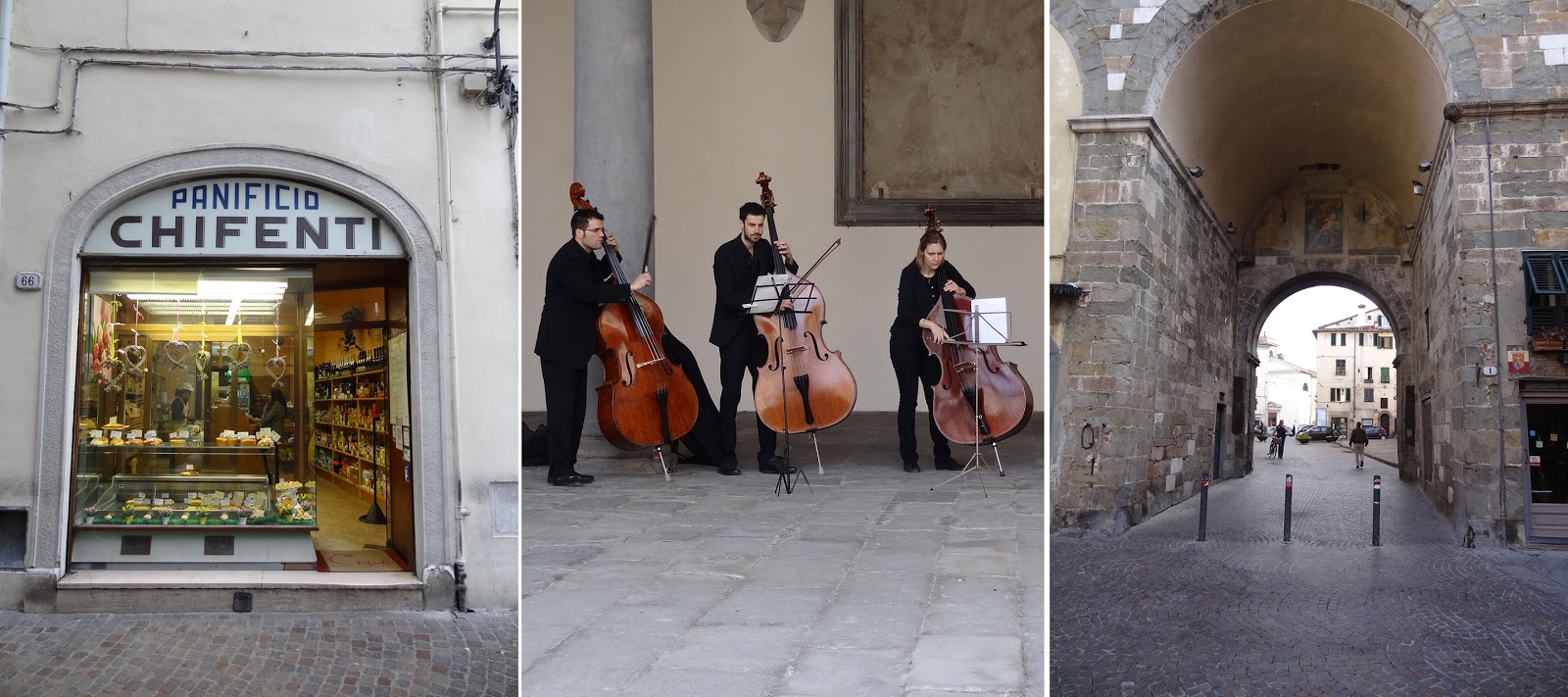
Sites while wandering Lucca.  The bassists were pretty good, but they were playing behind a dancer and she wasn't so good, so we didn't stay long.
Lucca was a cool place to live.  We did of lot of shopping like the locals (bread at that store, meat at another, veggies at a third, etc…) and cooking up tasty meals.  We also quickly got in the habit of getting a little something sweet, which we call our little “sumpin, sumpin” each and every day.  Usually it is gelato.  But eclairs and tiramisu and cannelloni are not out of the question either.  One can never over-estimate the promise of a treat when trying to motivate the kids to walk that one last half a kilometer to see that one last church of the day.  And when I say “the kids,” I’m including myself and Carol, as well.  Carol brings up at least once a day that she marvels that all Italians are not obese, what with all the pizza and pasta consumed, and with a gelateria at every other door on every street in the country.  We are walking many miles every day.  Often, the walks include an ungodly number of steps.  And yet, I fear the Thies clan has collectively passed the 500 pound barrier for the first time ever.  Thanks for that, Italy!


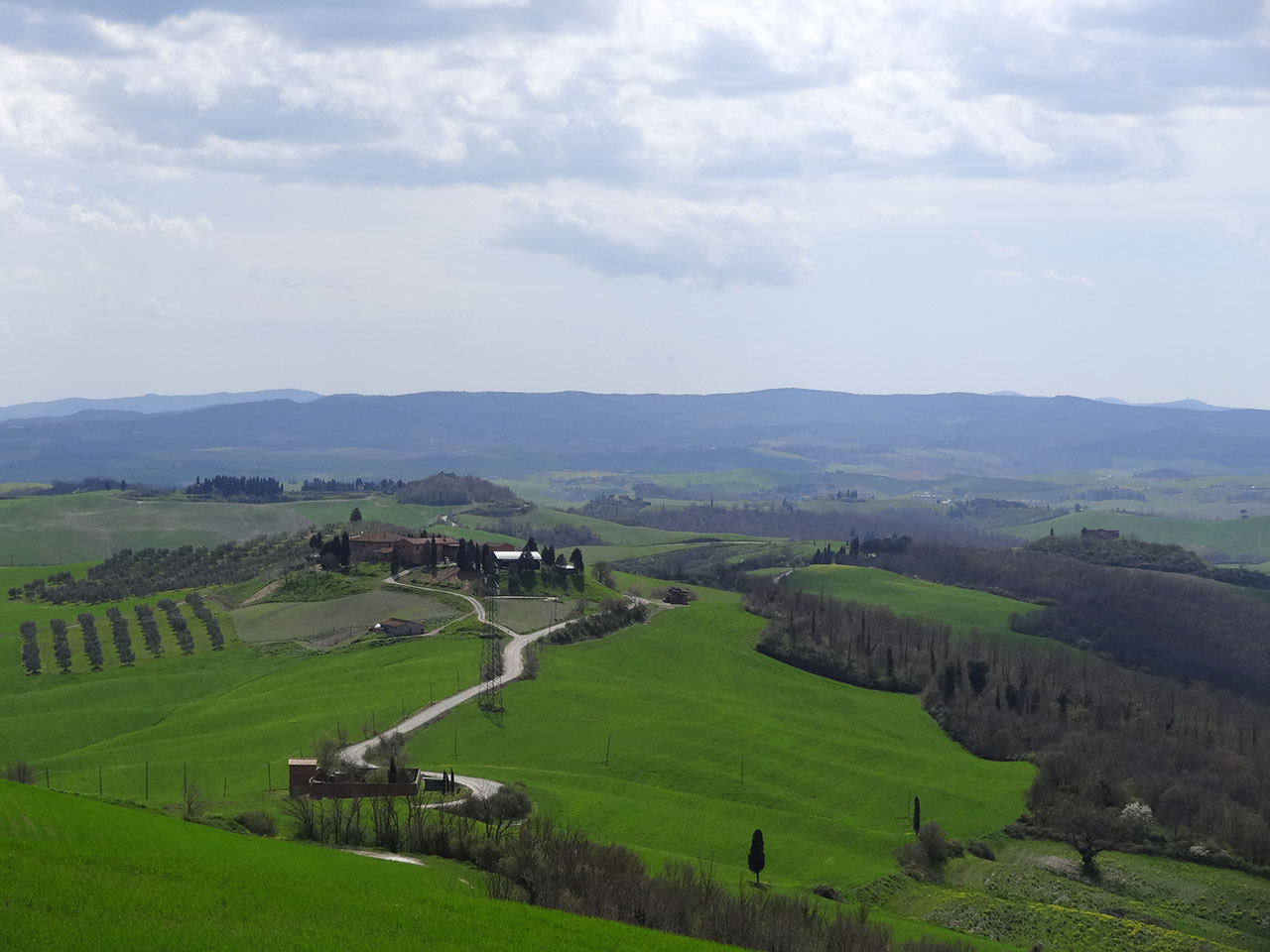
The Tuscan countryside.
Lucca was mostly just a good jumping off point for other day trips.  We did the Cinque-Terre thing one very long day.  These are five coastal hillside towns that are connected only by hour-long walking paths and a rinky-dink train system.  Each one is more scenic than the next, so if you are doing it right, you have to visit all five.  We managed to do it, but only by promising ourselves a pick-me-up at each stop.  Breakfast pastry at the first, lunch at the second, gelato at the third, a slice of pizza at the fourth, and dinner at the last town.  I don’t want to make it sound like there was no draw other than the food.  The views were amazing.  The towns were incredibly quaint and picturesque.  I had an epic day.  It was just a lot of walking and driving and train catching.  It turned out that all of the paths between towns, including the famous lovers’ path, were closed due to landslides.  We were bummed in the beginning, feeling we were missing out on views and such.  But by the end, we were thrilled not to have done any more walking than we did.  Plus, I was longing for a romantic train ride experience in Europe, right?  So we took the three minute train ride through tunnels between towns and walked our feet to death within the towns.  It was a good day.


Three of the five Cinque Terre towns from a distance.
Another day trip was to Pisa.  The cathedral was cool, but really, the only reason to go there is the Leaning Tower.  Chloe was in charge of describing that experience, so I’ll leave that up to her:

Chloe: My family and I visited the Leaning Tower of Pisa. I was really looking forward to seeing something that I knew about prior to the trip. Even though we have gone to so many amazing places, I didn’t really know about many of them before we got there. So to go to a place that I had wanted to go to and be able to cross that off my list was so exciting.

Here are some interesting facts that I learned about the Leaning Tower or Pisa. In 1173 construction was started on the tower. The plans consisted of eight stories each twenty feet high, a stairway with 295 steps, and seven bells each with a different note of the scale. About five years after they started building, they noticed that the tower had started leaning. To solve the problem they decided to start building the following stories taller on the leaning side, which in the end caused the building to resemble a banana. The tower continued to lean. To this day the top of the tower leans sixteen feet away from the base of the tower. Galileo took this as an advantage to present his theory that even if two objects are different weights, they will hit the ground at the same time if you drop them at the same time. He went to the top of the tower on the side further away from the base with two differently weighted cannon balls. Then he dropped them, and sure enough they landed at exactly the same moment.
 

My favorite part was climbing up the leaning steps. The steps wound around the tower with a wall on both sides. As we climbed the steps on the side that was leaning towards the ground, we slid against the outside wall. Then we moved toward the middle of the tower and we were able to move to the middle of the steps. Then we tilted towards the center of the tower as we progressed up the stairs. We went round and round like that till we reached the top. The parts on the steps worn down by people’s feet followed our pattern of where we were walking with the leaning of the tower. I liked how they put windows every so often so I could progressively see how far up I was. When we reached the top and looked over the balcony, the view was spectacular. We could see so many people, houses, and lots of green land. We also could see the top of the large church standing next to the tower. I am so glad that we got to go on this amazing visit to the Leaning Tower, and I cant wait to find out what we will do next.


Steve:  There you have it.  One satisfied customer.  We aim to please.
She's not trying very hard to straighten it out.  C'mon put your back into it!
A third day trip from Lucca was Florence.  Now I know, many are asking how we could possibly make Florence a day trip, as there is far too much to see in a day.  But let me remind you that we are travelling with a ten year-old boy who is about as interested in art museums as he is in Brussels sprouts.  (I can’t wait for Belgium!... No that’s not a non-sequitir, go find a map of Belgium.) My point?  We have to pace ourselves with the museums.  We tend to go into as many churches as possible, and use the frescoes and statues and architecture as our art lesson props.  So rather than actually going into the art museums, we compromised by walking around them and checking out all of the free exhibits outside the walls.  We had Josh write a book report on a story about Filippo Brunelleschi, the architect behind the first-of-its-kind giant Duomo, so that Josh would be more interested in it when we climbed up.  Here’s Josh report (Brunelleschi’s nickname was “Pippo”):

Josh:  In the book, Pippo the Fool, which is a real story, there is a young man named Filippo who is an inventor.  He made crazy inventions that nobody wanted or cared about.  When the news passed by that there was a competition to design a huge dome for the cathedral, way bigger than anything of the sort, ever, he went to work right away.  He didn’t care that a famous artist named Lorenzo said that a fool like him would never win.  He thought and thought and designed and crumpled reject ideas until finally after about a month he had his perfect design. He was ecstatic. 

The day to show it to the judges came and he got in line.  The first couple of designs by others were horrible.  One was so heavy there would be no way to support it.  The next one was the opposite.  It was made out of feathers and coins, which somehow the designer managed to get to stand up, but the first storm would blow the feathers away.  Lorenzo’s looked perfect, unfortunately for Pippo.  Except, when the judges noticed that there was so much wood necessary that they would have to chop down every tree in Italy.  So that really wouldn’t work.

Then it was Pippo’s turn.  They found it was all stone and bricks.  They asked how it would stay up but Pippo wouldn’t tell because he didn’t want anybody, especially Lorenzo, to steal his ideas.  They laughed and told “Pippo the Fool” to go home.  He didn’t give up.  He built a model with some help from a friend, and it took only a little while since he didn’t doubt himself and worked so hard.  He had so much confidence he rushed right away to tell the judges to come.  They walked around in the model and saw what he designed.  There was an inner dome supporting the outer one and chains that connected them.  The chains were not visible because they were hidden behind the inner dome.  It was ingenious.  He was so happy that his design was going to be the chosen one for the famous town cathedral, until he was told that Lorenzo would be his working partner.  But he persevered anyway.

Pippo worked with the laborers and told them what to do while Lorenzo lazed around and talked to the saleswomen.  More days passed by like this and then one day Pippo decided to rest as we was so tired from all of the hard work.  The workers looked toward Lorenzo for help and Lorenzo just shrugged and tried not to look stupid, which he did.  Lorenzo got fired on the spot.  When Pippo was back at work, he was much happier that Lorenzo was gone and he was not exhausted anymore.  It took him about sixteen years to build the dome and Pippo worked hard.  When he was all done he had so much joy he felt like jumping up and down.  He was also happy that his nickname was changed to something that suited him: “Pippo the Genius.”  

Pippo’s example can teach us many lessons in life and they are very important lessons.  As you read you found he had a lot of confidence in himself, he always worked hard, he wasn’t sensitive about other people’s insults and most important of all, he never gave up.  Sometimes, it takes more than just genius to succeed.  Take that, Lorenzo.

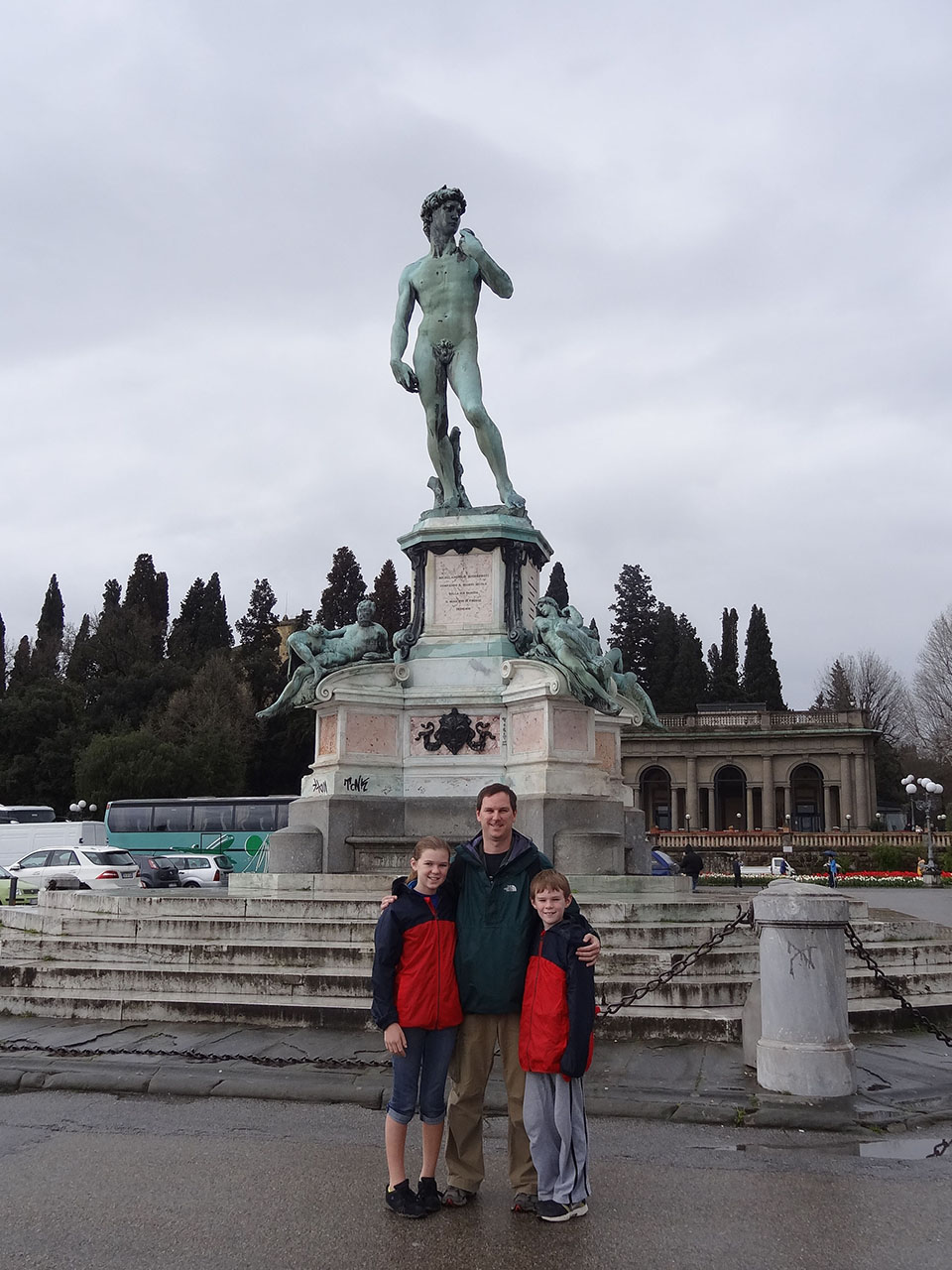
Steve:  The Duomo was pretty amazing.  We climbed up and took in all of Florence from one lofty perch.  We did see both life-sized replicas of Michaelagelo’s “David” up close, which seemed just as good as paying to see the original in the museum.  We also saw the famous campanile.  We spent quite a bit of time in the Leonardo Da Vinci museum playing with the interactive exhibits.  That kind of genius is more up my alley.  Art appreciation is Carol’s bowl of cherries.  And yes, we did get a little sumpin’ sumpin’ there too.
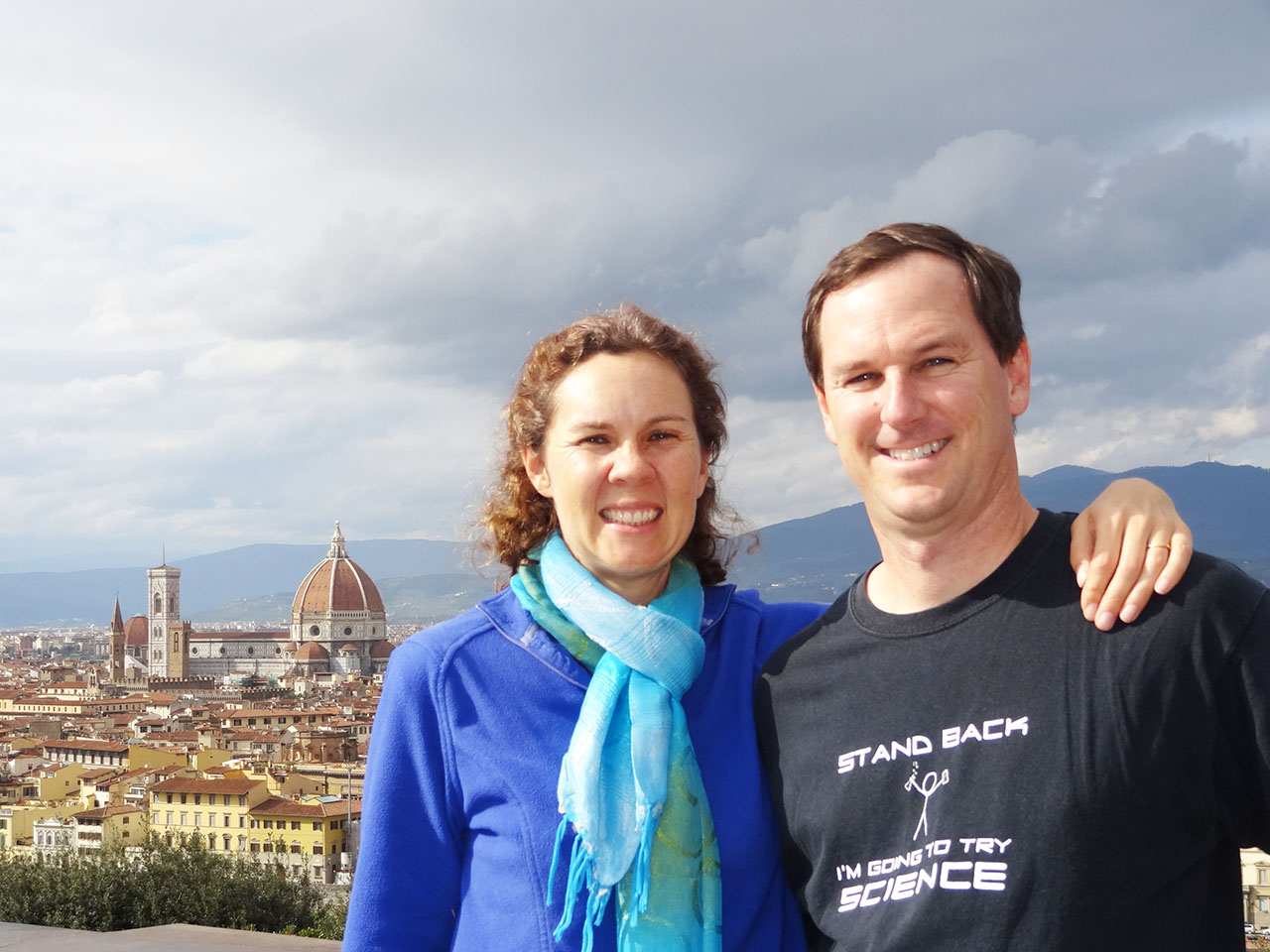
Duomo in the background (at least a mile away) 
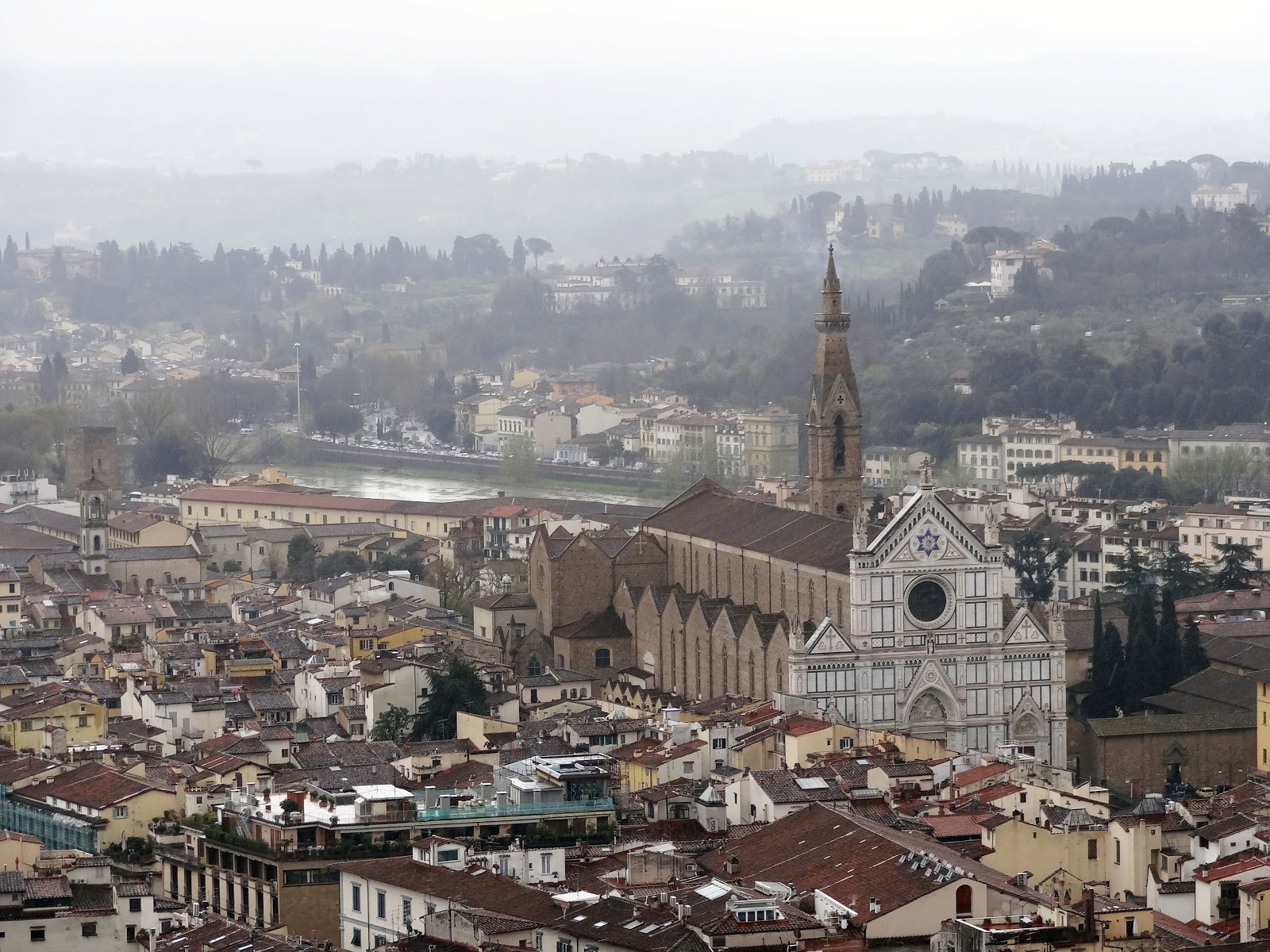
Florence from the top of the Duomo
What's David got that I don't?  Don't answer that.  Completely rhetorical.
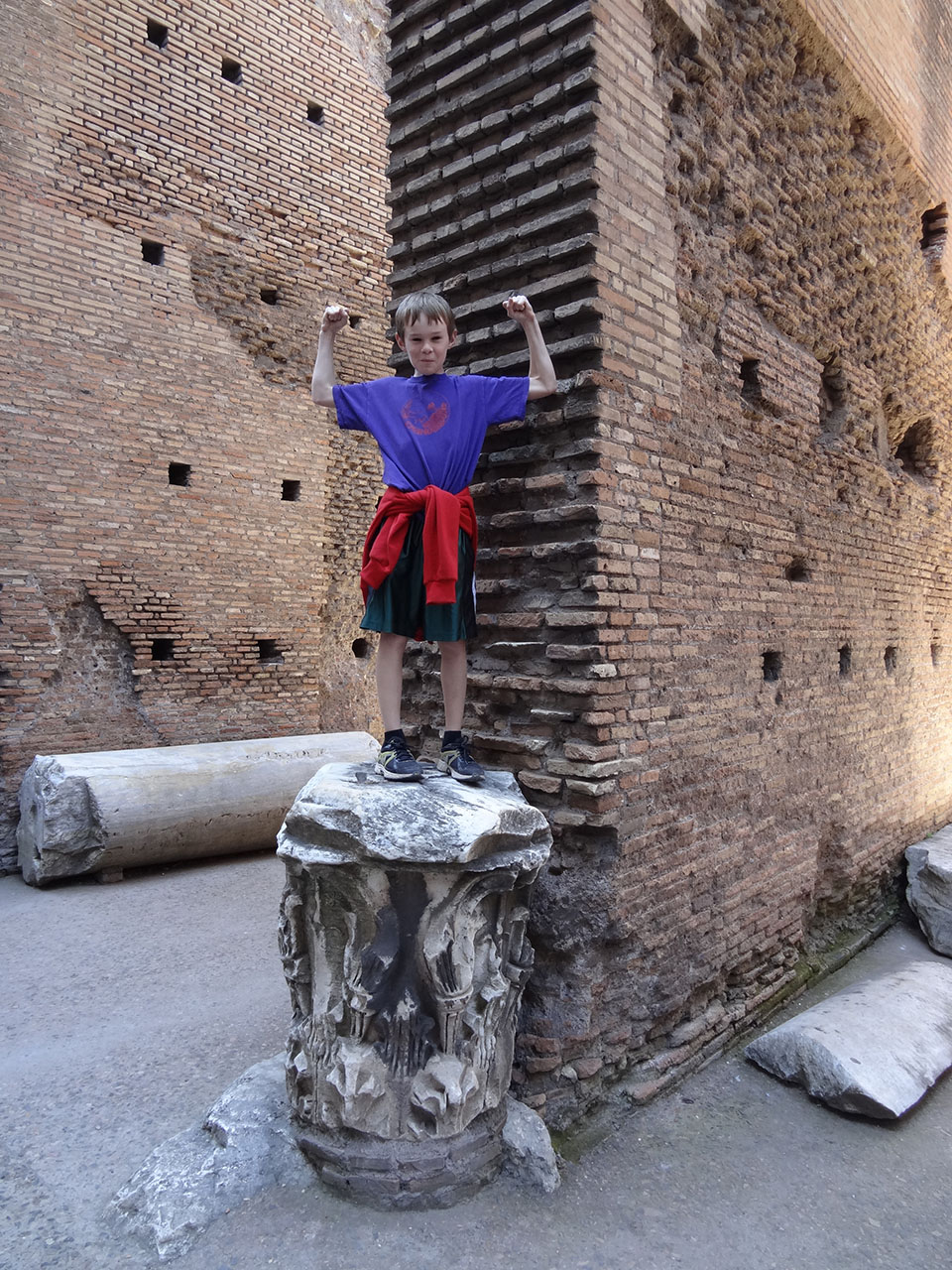
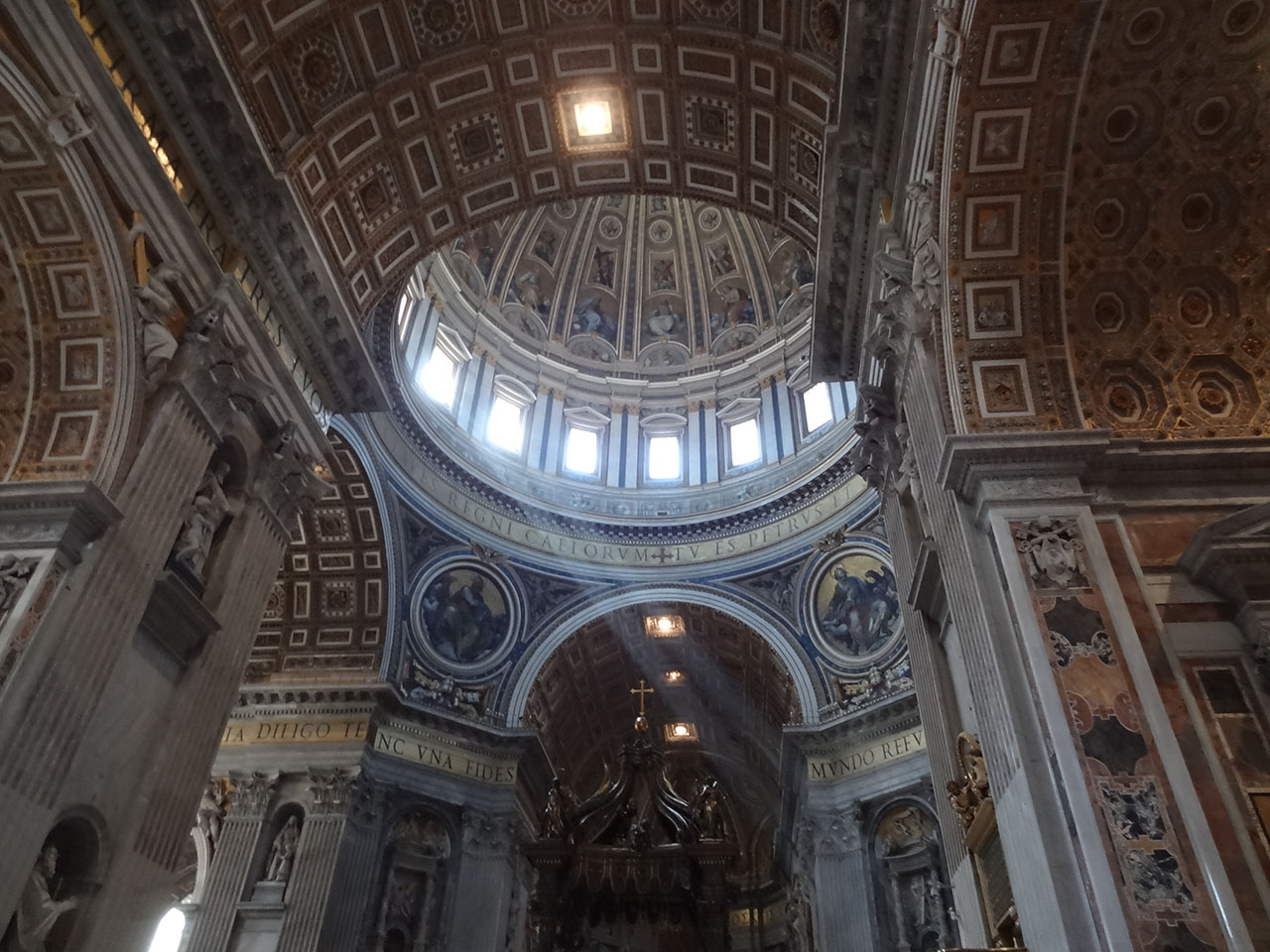
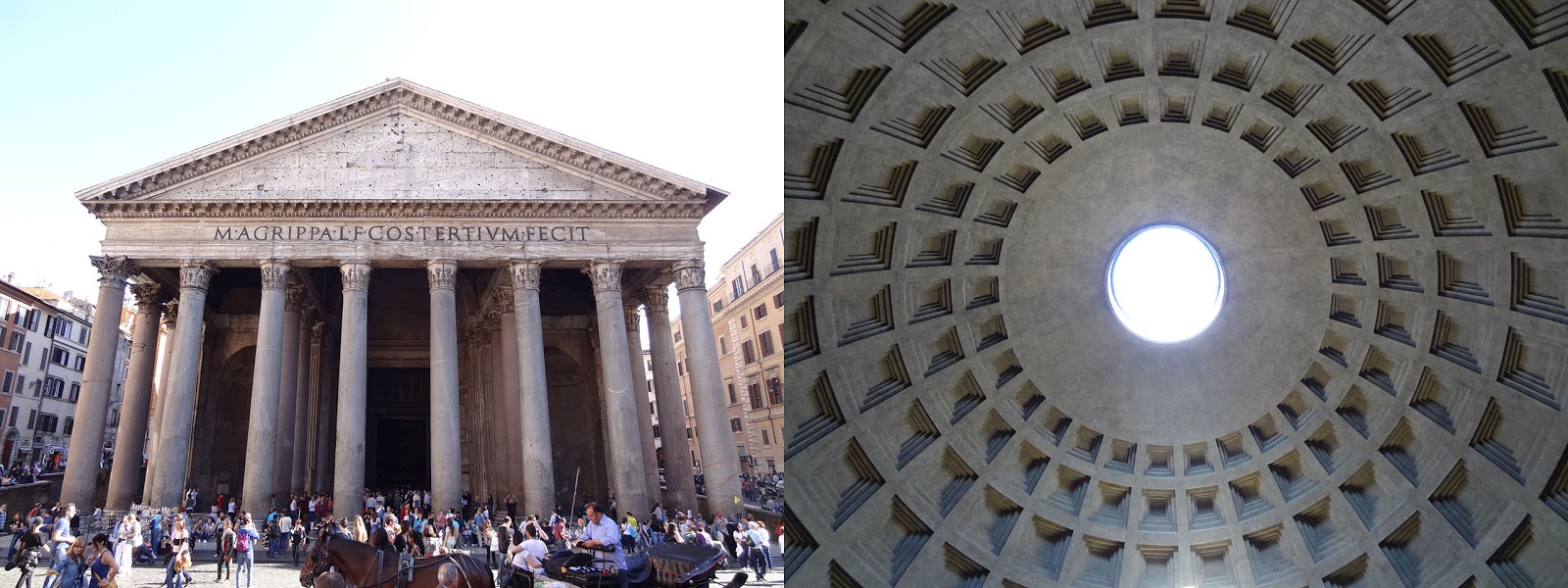
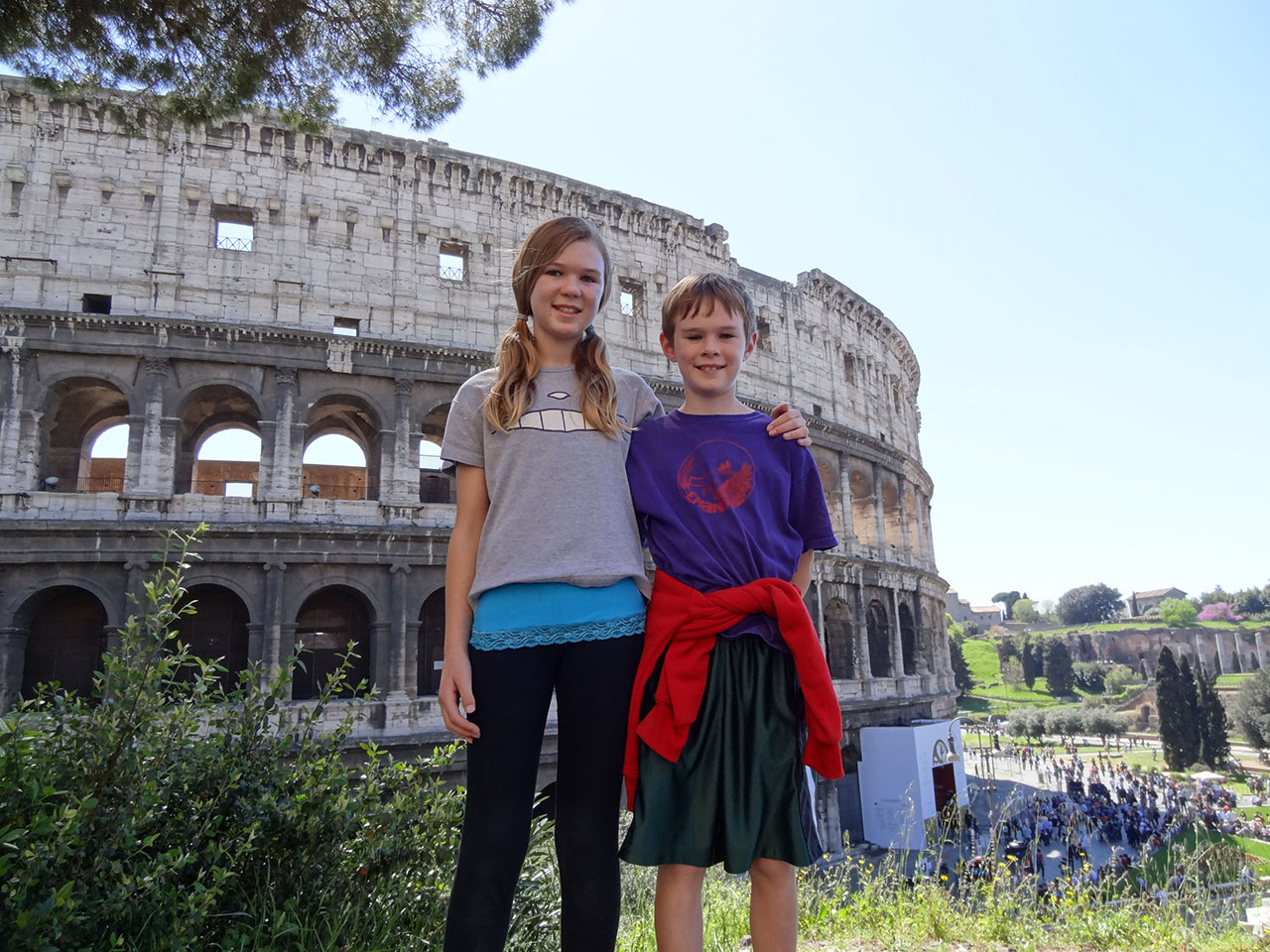
From Lucca, our next stop was Rome.  In the interest of financial  solvency, we only spent three nights there, giving us two full days of whirlwind sightseeing, before we went broke.  This first day was all about ancient Rome (the Colisseum, the Forum, the Palatine Hill, and the Pantheon.  We even squeezed in a visit to the Trevi Fountain and the Spanish Steps.  That was a full day, but even the kids were impressed, and that’s not easy to make happen.  The second day, was a guided tour through the Vatican Museum and St. Peter’s Basilica.  The Vatican was awful for all of us.  There were so many tourists that we shuffled along from room to room at a snail’s pace without even enough elbow room to breathe properly.  Yes, I breathe with my elbows.  I’m sure the art was amazing, but I couldn’t see most of it, and the feeling of being cattle led to the slaughter ruined the rest.  The tour was hard to hear, and didn’t add much to the experience in any case.  I was pretty bummed by it all.  The Basilica was a different sort of breathtaking however.  The amount of work that went into it is mind-boggling.  The master-craftmanship behind all of the details was incredible and, of course, the art is unsurpassed.  Even a hack like me could appreciate this.  Those Catholics sure know how to put on a good show.

Rome Art

Aah Josh.  Now we have to pay for it!
Guess why Carol chose this photo.  Never mind.  Don't.  Just move on.  Nothing to see here.

St. Peter's Basilica

The Pantheon

The Coliseum.  No, Josh didn't break that little chunk off. It was like that when we got here.  I swear.
Rome was impressive, no doubt.  The Greeks are the ones responsible for the birth of math and science and realism in art.  But the Romans took all of that, and made it twenty times as grandiose.  Carol keeps reminding me that the Romans are the ones who invented the arch, and that is why they could build so big.  But just because you can go big, doesn’t mean you are going to in every way.  The Romans, they knew big.

My favorite “stupid gringo” story from Rome happened immediately upon arrival.  The little old Italian lady who showed us into the apartment was having too much trouble with her English to explain to me where I could go to buy bus tickets for the next two days of sight-seeing.  So she asked me to follow her down to the parking lot so she could point the way.  Carol asked if I wanted her to come, but I said “no, I’d be right back.”  Well the little old lady then proceeded to ask me to get into my car and follow her as she drove home, because the grocery store and the shop for the bus tickets were on the way.  I balked.  “Can I go tell my wife what’s happening?”  “No,” she said, “she was in a big hurry.” It wasn’t far, she promised.  I would be right back, no problem.  Picture the little old lady insisting I follow her.  Italian grandmothers don’t take “no” for an answer.  Details.  What was I to do?  We started driving.  How long could it take?  Well, traffic was insane.  I almost lost her twice in her tiny little clunker, as crazy drivers took every opportunity (red light or no) to cut in between us.  We only went a mile, maybe.  It took twenty minutes, and involved six turns and two roundabouts which would make the return trip challenging.  Carol is going to kill me, I think.  I don’t have a phone.  I was going to be right back.  Never drive in Rome, even ten miles outside of the city center.  And, never, ever, believe a little old lady when she says “no problem.” 

She shows me the grocery store parking lot (one of those cramped garages where they park your car for you to maximize space.)  She points out the tobacco shop where bus tickets are sold.  She leaves.  I park.  I run to the tobacco shop.  Nope, no tickets left.  But the one down the street next to the McDonalds should have some.  I run, six blocks.  He’s only got the three-day passes.  Fine.  I’ll take ‘em.  I run back the six blocks to the car.  You can’t park here unless you’ve used the grocery store.  Fine.  I run to the store.  I buy breakfast for tomorrow.  I wait in the looooong check-out line.  I’ve forgotten to weigh and stamp my own bananas (if you haven’t read the Provence blogpost, you won’t understand why this is so funny).  The check-out guy takes pity on me, gets up, and goes to do the weighing himself.  I pay.  I go back down to the garage.  “Where’s your validation ticket?”  What do you mean?  You didn’t say anything about a ticket last time.  Look at my bag of groceries, it’s got the name of the store stamped across it.  “Sorry, no ticket, no car.”  I run back upstairs.  I get the ticket from the same check-out guy.  He’s chuckling and shaking his head.  I run back down.  I finally get my car.  I try to drive back the way I came, but one-way roads are making that incredibly difficult.  The traffic isn’t helping either.

When I finally arrived at the apartment, well over an hour had gone by.  Carol was in tears.  First she had imagined I was lost.  Then she imagined I was dead on the side of the road.  First she was worried.  Then she was terrified.  Now she was just plain pissed.  I had said I’d be right back.  How could I possibly have taken so long?  I was just supposed to be walking to the parking lot and back.  Well, at least I got the bus tickets, right?  Wrong.  We had agreed to get the Roma Pass, which included transportation along with the entrance fees to the sights.  Smooth move, gringo.

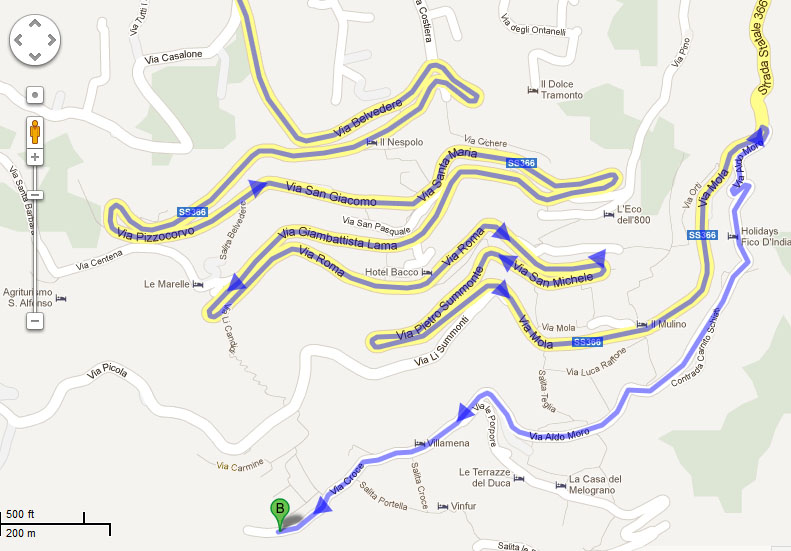
From Rome, we continued south to the Amalfi Coast.  This week was like a slice of Heaven on Earth.  I snapped more pictures per minute here than I have anywhere else on our trip.  Such natural beauty shouldn’t even be legal.  The rest of the world is envious.  Sparkling turquoise seas with waves crashing on chiseled cliff walls.  The towns are built against the hillsides rather than on them, as horizontal lines cannot be found anywhere on the landscape, only vertical.  I’ve included a snapshot of the Google Maps showing the switchbacks we had to drive on to get anywhere.  A one- mile distance as the seagull flies would become a five-mile trip back and forth up or down the mountain, and would take forty five minutes, easy.  The roads were so narrow that you’d have to stop more often than not to let a car go by in the other direction.  Curves were treacherous.  Crazy Italian drivers didn’t make it any easier.  But the views made up for all of that in a heartbeat.  If they built a funicular or two, I’d move here in a heartbeat.
Feeling carsick yet?
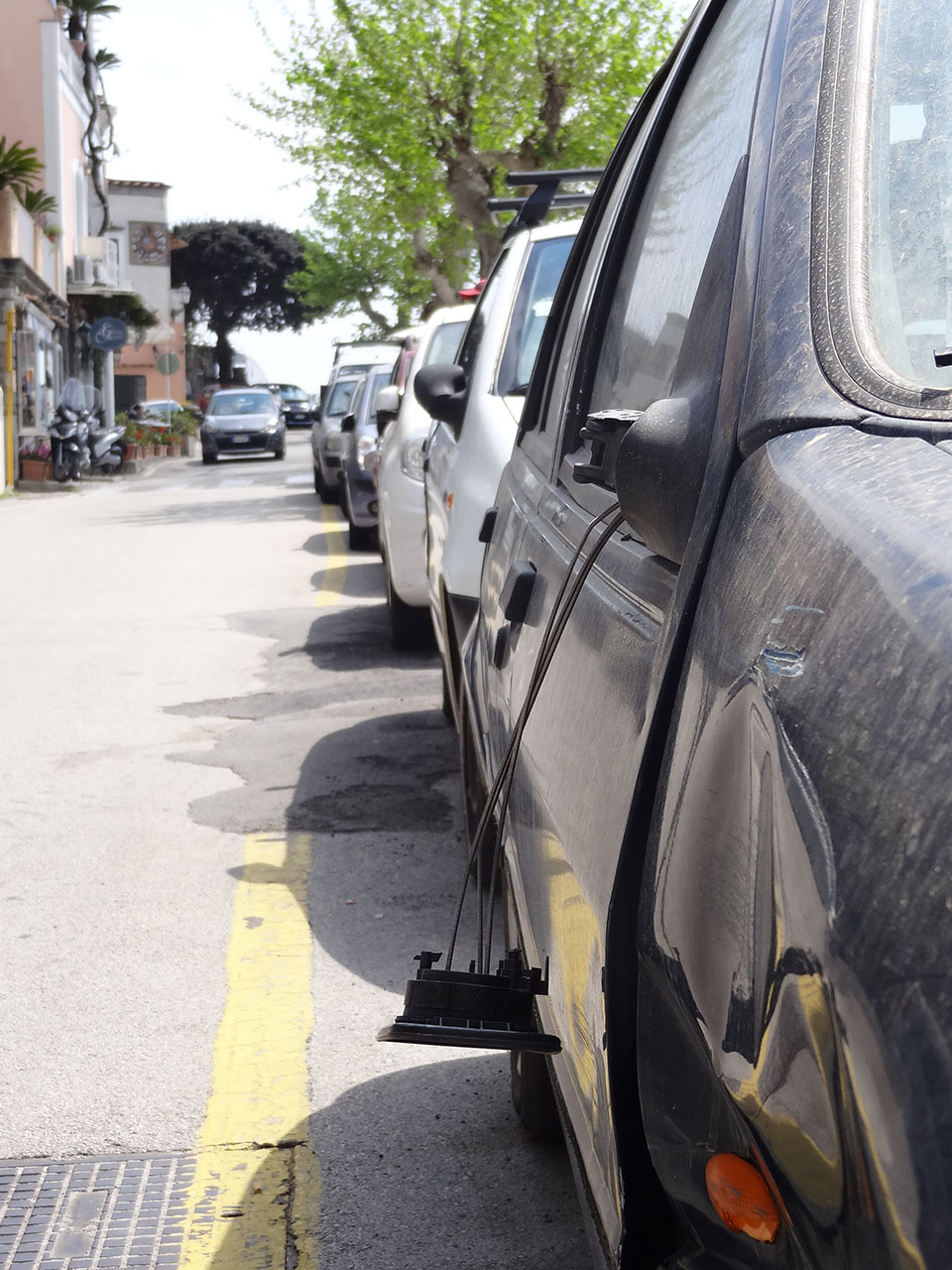
Though this is not one of those narrow roads, here's why you fold in your mirrors on them.  
We lived in a super-cute little house near Amalfi town with an ocean view to die for off the front porch.  We bought one of those picturesque 1000-piece Ravensburger puzzles to build on our kitchen table (we’d use the patio furniture to eat, don’t want to waste that view!).  The day after we finished the puzzle, on a visit to Positano, the next town over, we noticed that the view we were witnessing in person was the puzzle picture exactly.  Views so good, they make puzzles out of them!  Things like that are only supposed to happen in Yosemite.  I like it.
Our front patio and the view from over that metal fence.
The completed puzzle and the view from our walk in Positano the next day.
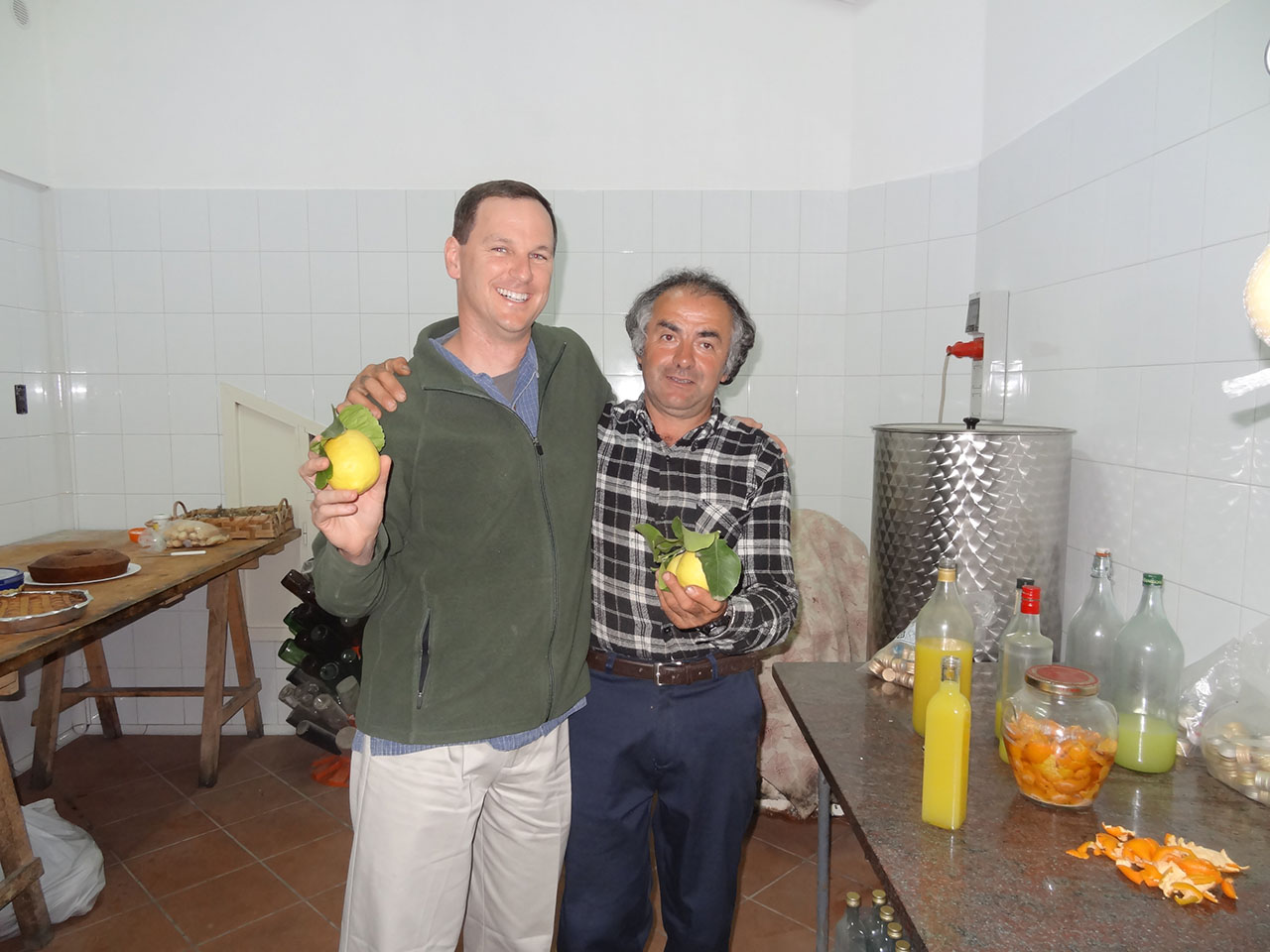
Carol and I had dinner at an Agriturismo, which is basically a farm where they bring tourists in to eat meals and/or stay for the night.  The many course meal was wonderful.  The setting was cool.  A stone walled room inside a hill, except on the side open to the sea, a thousand feet below.  Cozy.  The company was excellent (two other couples, one from Chicago and the other Toronto).  We compared travel notes for hours.  But the best part of the evening was the visit from the owner.  His daughters and wife had been serving us the whole evening.  He showed up at the end with a few bottles of homemade alcohol (limoncello, and a couple of variants using mandarins and fennel – awesome, all three!) Then he talked and told stories and made friendly conversation for over an hour with us.  His English was spotty at best.  But he made his points known through effusive hand gestures and body language.  He was probably sixty years old or so.  Not that this is especially old (I’ll be there soon enough) but I bring it up because, despite his age, the best way to describe his effusiveness was “cute.”  He was a cute little man with his enormous smile and his waving hands and his enormously thick accent.  He was a living caricature of the friendly old Italian grandfatherly type that you see in the movies and that you’d never expect to actually meet in real life. 
He reminded Carol of an elf.  We're holding lemons from his farm.  that is my gift bottle of  limoncello on the table.
He gave us an extra bottle of limoncello for the road, and a large portion of the quiche they had made for the next day’s breakfast.  He insisted we visit his storerooms and inspect his salami and his tomatoes and his lemons and that we take pictures with him.  It was like he was our own Italian uncle who we’d finally come back to the homeland to visit after all these years, and he was brimming with excitement to share his world with us.  Only we were just there for dinner.  Awesome.  I was going to say that I find the average Italian a bit less friendly than the Barcelonians or the French (from Provence at least) or even the Moroccans.  But after the encounter with our new Papa from Amalfi, I think he upped that average single-handedly into new unreachable heights for the rest of Europe.

There is one other episode worth recording on the Amalfi part of the trip.  The owner of the house we were living in suggested we take the famous “1000 steps” walk down to the sea as it began right at our front door.  Some famous Italian movie was set along this walk.  She said we should walk down and then catch a bus back up.  OK, who were we to question the advice of a local?  Let’s do it!

The walk down was pretty sweet.  There were more than 1000 steps to be sure, somewhere between 1300 and 1400, I think.  And these were tall steps, the kind that rattled your knees with each landing.  Walking back up was not going to be an option. That was eminently clear.  Though we did pass by a few people who were attempting it.  More power to them.  Not for me! 

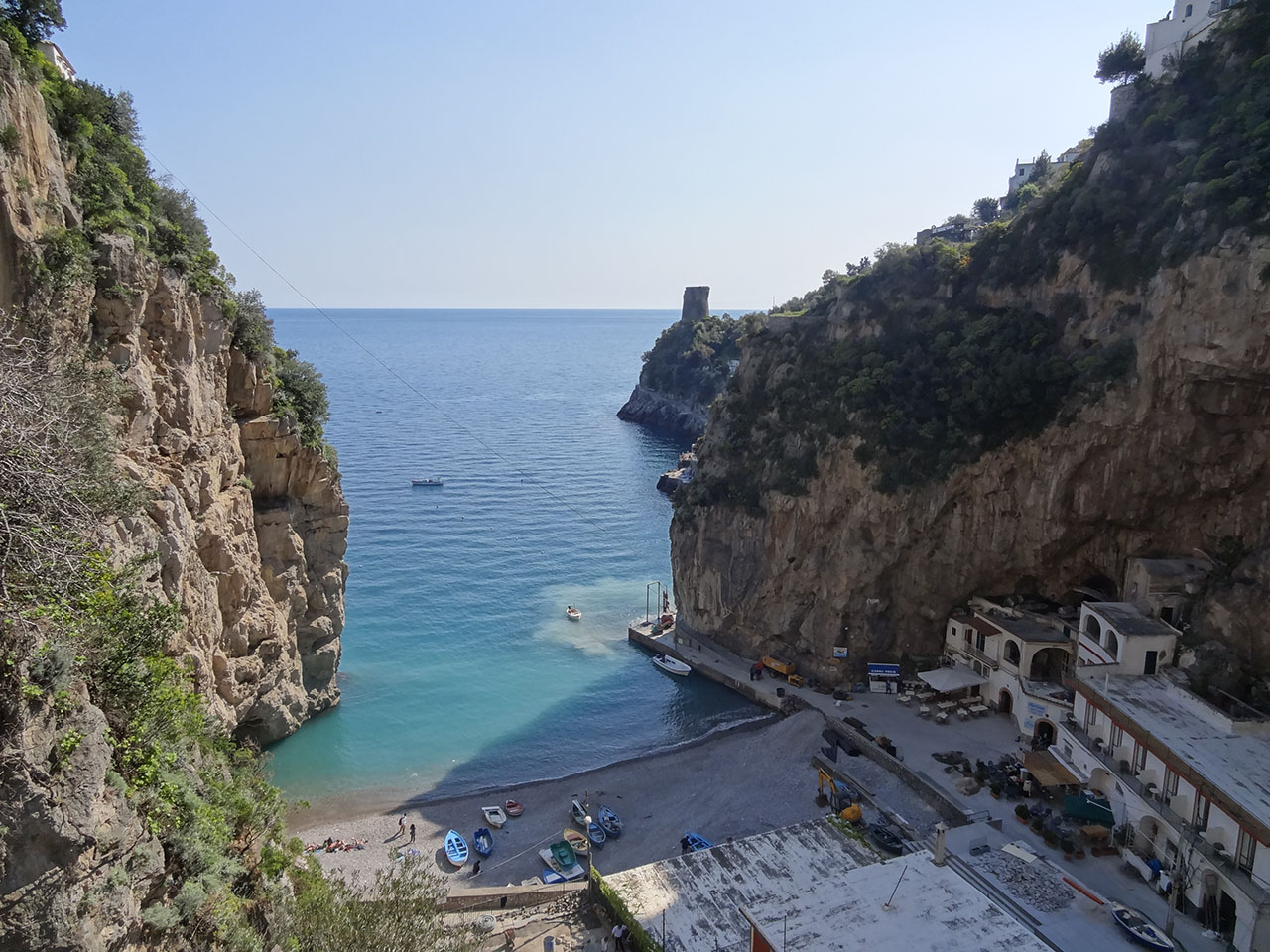
We eventually got to the bottom, which was a spot where a rushing river met the Mediterranean after having spilled down the sheer cliff walls for a few miles.  There was a rocky beach, where we sat amongst the pebbles, collecting shards of ceramic work that had been discarded over the years during various path-tiling projects and had been turned smooth by time and water.  Josh spent his time skipping stones and building a dam with all the rocks he threw in the river.  A couple of hundred feet above us was an arching bridge over the river that supported the one roadway near the water that connected Amalfi with Positano.  Amalfi was apparently 5 km to our left, and Positano was about 15 km to our right as we looked out to sea.  We scaled another set of stairs up to the road and looked for a place to catch a bus.  It was still early, and we decided we’d head towards Positano to check it out, as we’d already been to Amalfi the day before. 
On the way down.
Our little fjord cove.  Turns out we should have stolen that boat... Read on.

First we had to identify a bus stop.  We hiked for maybe two kilometers along the road.  This was no easy task, as there were no sidewalks, and I already told you how narrow the roads are.  On the right side of the street was a natural cliff wall.  On the left side of the street was a manmade rock wall maybe two feet high “protecting” you from a fall down the cliffside and into the sea.  Whenever a car came flying by we had to straddle the wall or run to the other side of the road to keep from being either squashed or thrown to our doom.  Big trucks were extra scary.  So were the occasional tunnels that were cut to make the road possible.  I have to point out that I have huge respect for the engineers who built the roads in Italy and in Amalfi in particular.  There are probably a hundred times as many bridges and tunnels per km of road in this country than in California.  These roads make Highway 1 down the coast look like I-5.  We finally found what we thought was a bus stop, perched well above a tiny harbor that had a little beach and a couple of restaurants.  We waited.

Over half an hour passed by and still, no bus.  We had already seen one go by as we were walking to the bus stop, but there was no flagging it down on those crazy roads.  If it stopped somewhere that it wasn’t scheduled to stop, a twenty-car pileup would have shut the road down for the better part of the afternoon.  No, we would have to wait for the next one at the proper place.  Only we weren’t sure this spot was the proper place, and we didn’t know the schedule for the buses.  Was anything ever going to come?  Heck, we’d be happy to catch one going the other way at this point, back to Amalfi.  We’d have to go there eventually anyway, to catch something that would take us up the hill.  More time passed.  Nothing.  I even tried to hail a taxi that flew by once.  I got nothing but a wave from the driver, though.  I called our landlord and asked for the skinny.  She said something should come by soon, and that she’d call us a taxi if it came to that.  OK, we’ll wait.

Well a bus did finally show up, going towards Positano.  “Woo-hoo! We’re saved!” The kids go wild.  We piled in.  The driver asked for our tickets.  “Tickets?  I can’t just pay you?”  I was familiar with the ticket system from Rome.  But seriously?  Out here?  “Off the bus.  No ride for you.”  The bus left.  We were left standing there on the side of the road, no town in either direction for miles.  Plan B?  Plan B was to gripe about our landlord who neglected to mention the ticket thing, to gripe about the system, which was inane at best, and to scratch our heads about why we didn’t figure all of this out before we started down those darned steps; so much for spontaneity.  Plan B wasn’t very helpful, but we did feel better after implementing it.  Plan C was to call the landlord back and get that taxi.  No answer.  Great.  Let’s go back to Plan B.

Plan D was to walk the couple of hundred yards seemingly straight down to the harbor to see what the locals could offer us.  By divine providence, one of them had a boat taxi service.  He could take us to Amalfi in ten minutes for an insane amount of money.  At this point, we no longer cared.  We boarded the boat.  It was a pretty nice ride.  It was our first time ON the Mediterranean.  Within fifteen minutes we were standing in Amalfi, none the worse for wear.  We found out that bus tickets were sold in tobacco shops just as in Rome.  Really?  Oh, and by the way, you can’t buy stamps at the post office.  Those are at the tobacco shops too.  We bought a set of bus tickets.  They could keep the stamps.  We waited for another hour to catch the only bus that would take us back up the mountain.  We boarded, never being asked to produce a ticket mind you (a key detail, considering the fiasco a couple of hours earlier), and rode home (well, there was a fifteen minute walk from the closest bus stop, but that is neither here nor there… as “here” is Venice, where I’m finally getting around to writing this blog and “there” is wherever it is that you, my dear reader are doing your reading…)

That little boat on the way in to the dock was our way out.
Remind me to revisit this ticket-check thing when I write about Venice.  Craziness.

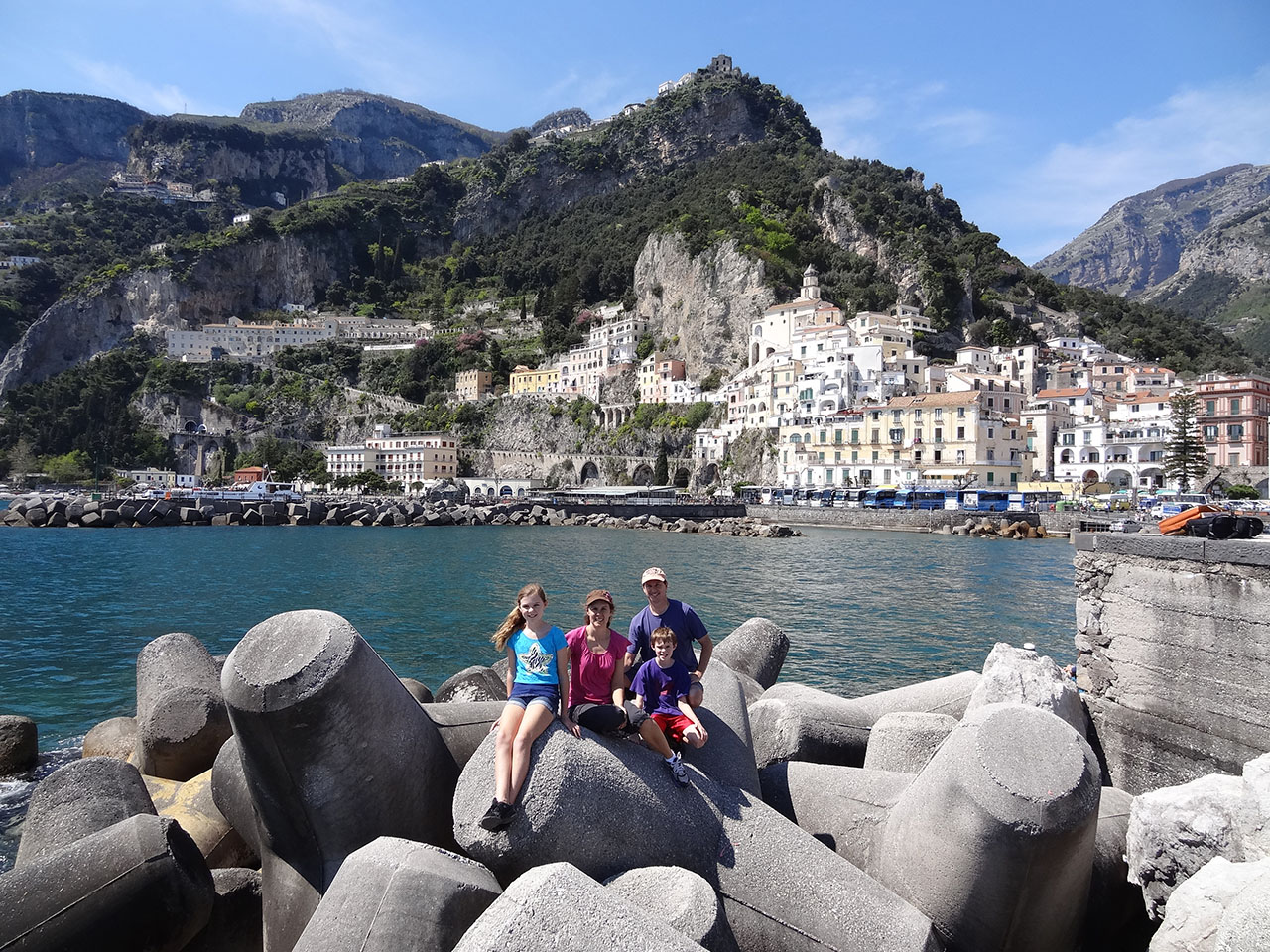
The photo op of my beautiful family was nearly ruined by the ugly view in the background at Amalfi.  OK, maybe not.
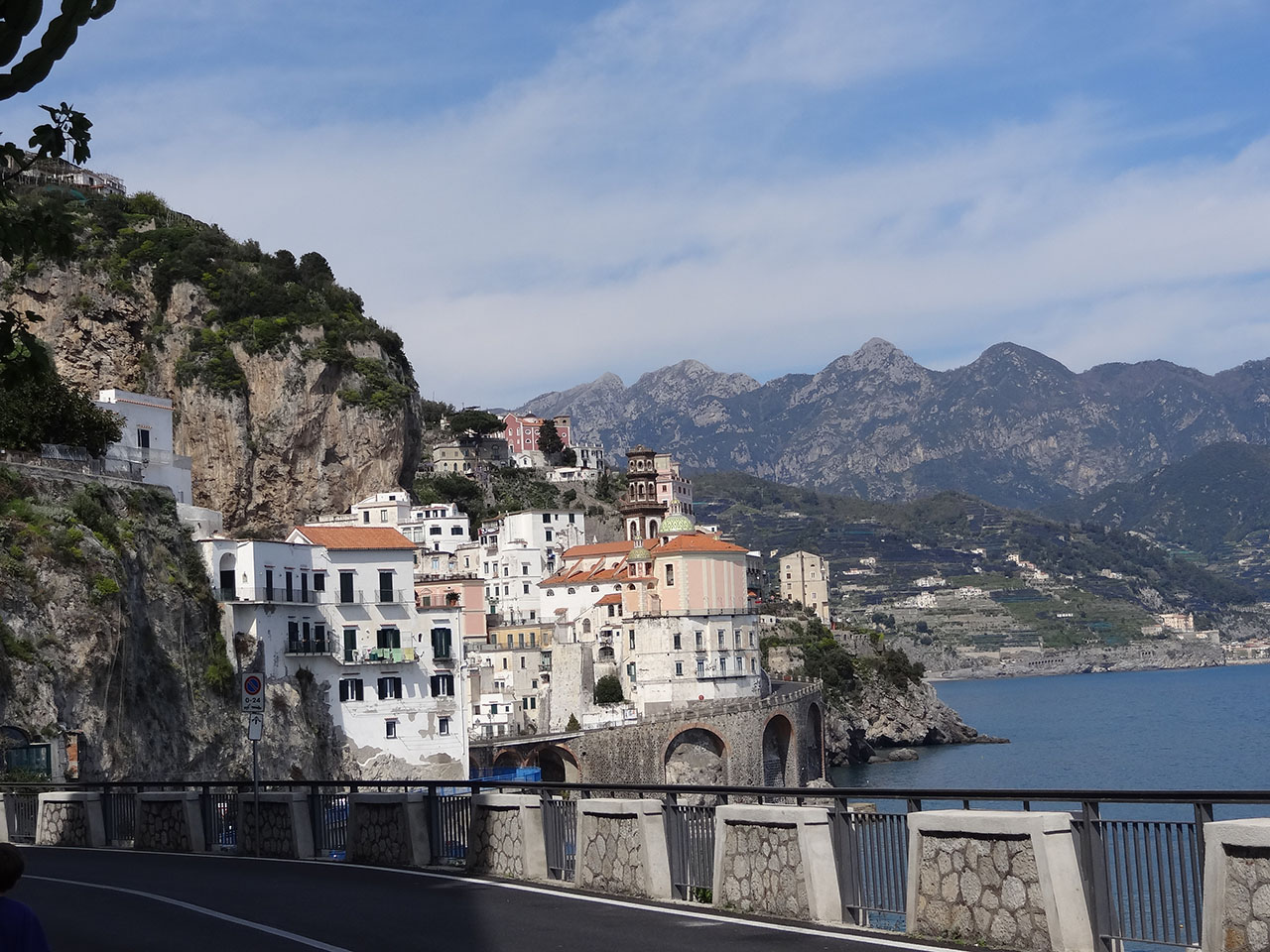
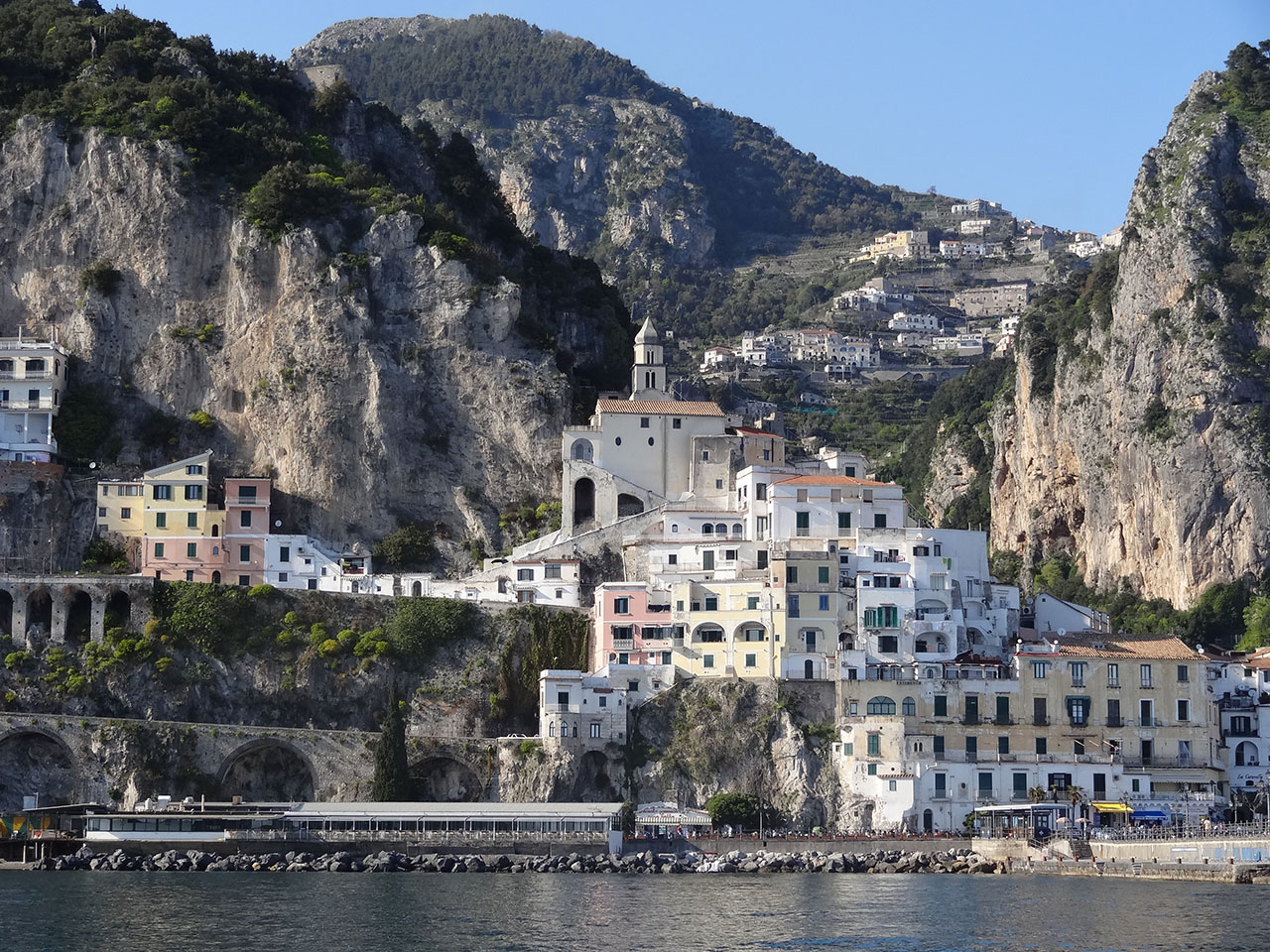
More Amalfi Town
More Amalfi Town

Stay tuned for Italia, Part II.  Pompeii, Assisi and Venice all to come.  I’ll probably throw Croatia in there for good measure.  That’s where we’re going next.  Ciao!